GSTR-9 Reconciliation Checklist: What to Match Before You File the Annual Return
Short answer: Before filing GSTR-9, reconcile the year month by month: outward tax in GSTR-1 against GSTR-3B, ITC claimed in GSTR-3B against GSTR-2B (which feeds Table 8A), tax paid in cash and through credit against the liability, and the previous year's invoices, credit notes and amendments reported in the next year's returns up to 30 November. GSTR-9 is due by 31 December after the financial year, and taxpayers with turnover up to ₹2 crore are exempt from FY 2024-25 onwards.
Last updated 30 October 2026. The due date and exemption are from section 44 of the CGST Act, rule 80 and Notification 15/2025-Central Tax, cited at the end. Screenshots are from MyPract, taken on 30 October 2026 on a live GSTIN, with every name, GSTIN and invoice number replaced and every amount scaled to sample values. This is practical guidance for taxpayers and their consultants, not legal advice.
GSTR-9 restates what the monthly returns already said. Most of the work is not filling the form but finding the months where the returns disagree with each other, or with the books, while there is still time to fix them in a return of the current year. For the portal steps of filing GSTR-1, GSTR-3B and GSTR-9 themselves, see our GST filing guide.
Who has to file GSTR-9, and by when?
| Return | Who files | Due date |
|---|---|---|
| GSTR-9 (annual return) | Regular taxpayers with aggregate turnover above ₹2 crore for the year | 31 December after the financial year[1][2] |
| GSTR-9C (reconciliation statement, self-certified) | Taxpayers with aggregate turnover above ₹5 crore | With GSTR-9, by 31 December[2] |
| GSTR-9A | Composition taxpayers | Not covered here |
Turnover up to ₹2 crore: no GSTR-9 from FY 2024-25 onwards[3]. The exemption is optional, and many firms still reconcile the year for these clients because the ITC and credit-note cut-offs below apply to everyone.
What are the cut-off dates that matter before GSTR-9?
Two limits make the reconciliation urgent, because a mistake found after them usually costs money:
- Missed ITC. ITC on an invoice of the year can be taken only up to the earlier of 30 November after the financial year or the date the annual return is filed (section 16(4))[4]. Filing GSTR-9 in October closes the window early.
- Credit notes and amendments. A credit note for a supply of the year must be declared by the same date, the earlier of 30 November or the annual return (section 34(2))[5]. GSTR-1 corrections for the year follow the same limit.
So the useful time to reconcile is October and November, not the last week of December.
How do you reconcile GSTR-1 with GSTR-3B for the year?
GSTR-1 reports outward supplies invoice by invoice; GSTR-3B is where the tax was declared and paid. For each month, compare:
- Taxable value and tax by rate, GSTR-1 (with amendments and GSTR-1A) against GSTR-3B Table 3.1.
- Credit notes, which reduce GSTR-1 but are sometimes not reflected in the 3B of the same month.
- Advances and B2C supplies, where timing differences are common.
A positive difference (GSTR-1 above GSTR-3B) means tax was under-declared: pay it through DRC-03 with interest before filing GSTR-9. A negative one usually means an invoice was left out of GSTR-1 or a credit note was missed; fix it in a current GSTR-1 before 30 November.
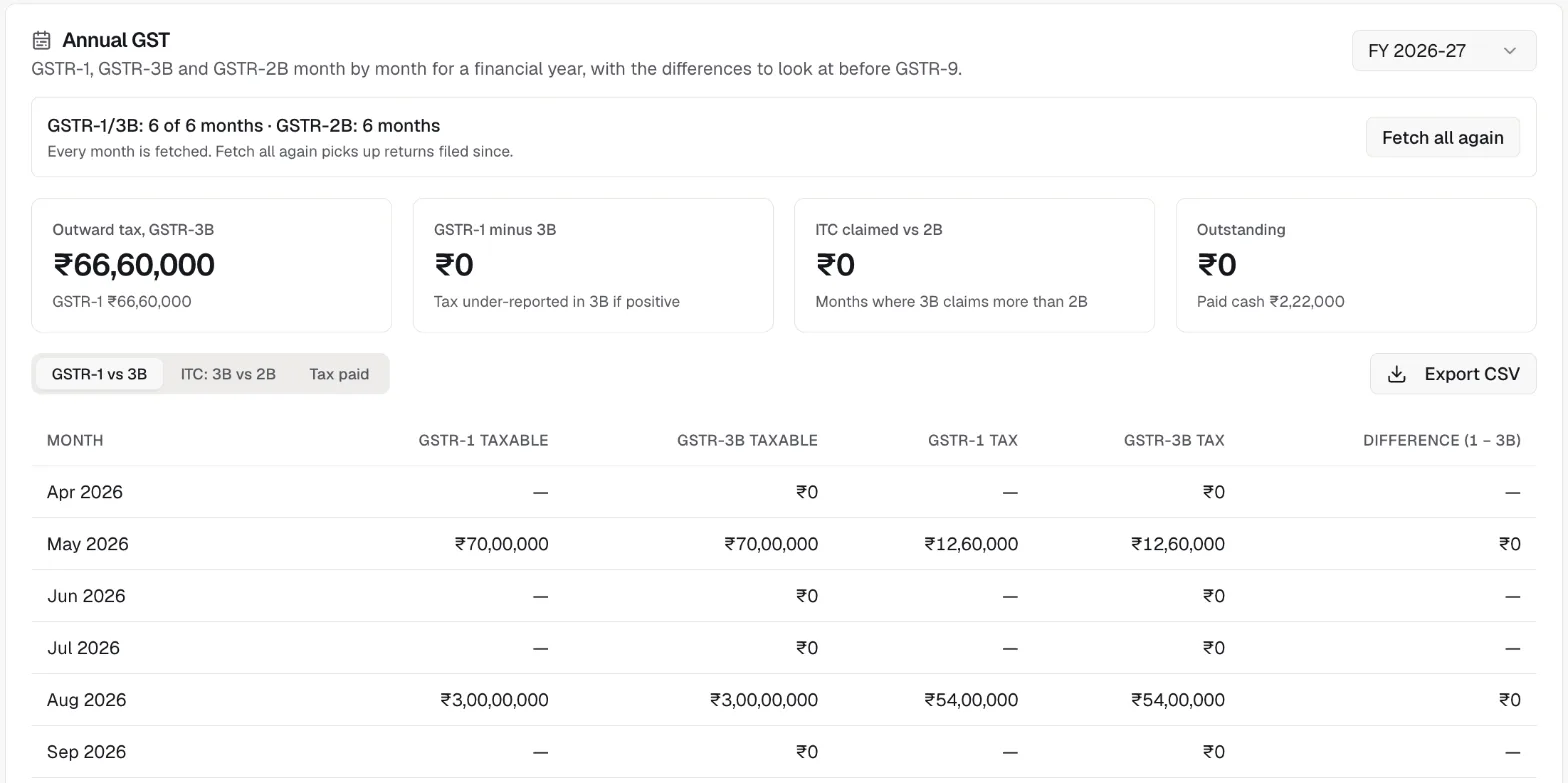
MyPract's Annual GST card (India, read-only) does this comparison for a client once its GSTIN is connected. Fetch year reads, one month at a time, the ledgers and the GSTR-1 and GSTR-3B summaries for every month that is over, and GSTR-2B for every month it has been generated. Fetch all again refreshes the year, which matters when returns were filed late. The headline tiles show outward tax in GSTR-3B against GSTR-1, GSTR-1 minus 3B (tax under-reported in 3B if positive), ITC claimed vs 2B and Outstanding liability with the cash paid; the GSTR-1 vs 3B tab lists each month's taxable value and tax from both returns and the difference.
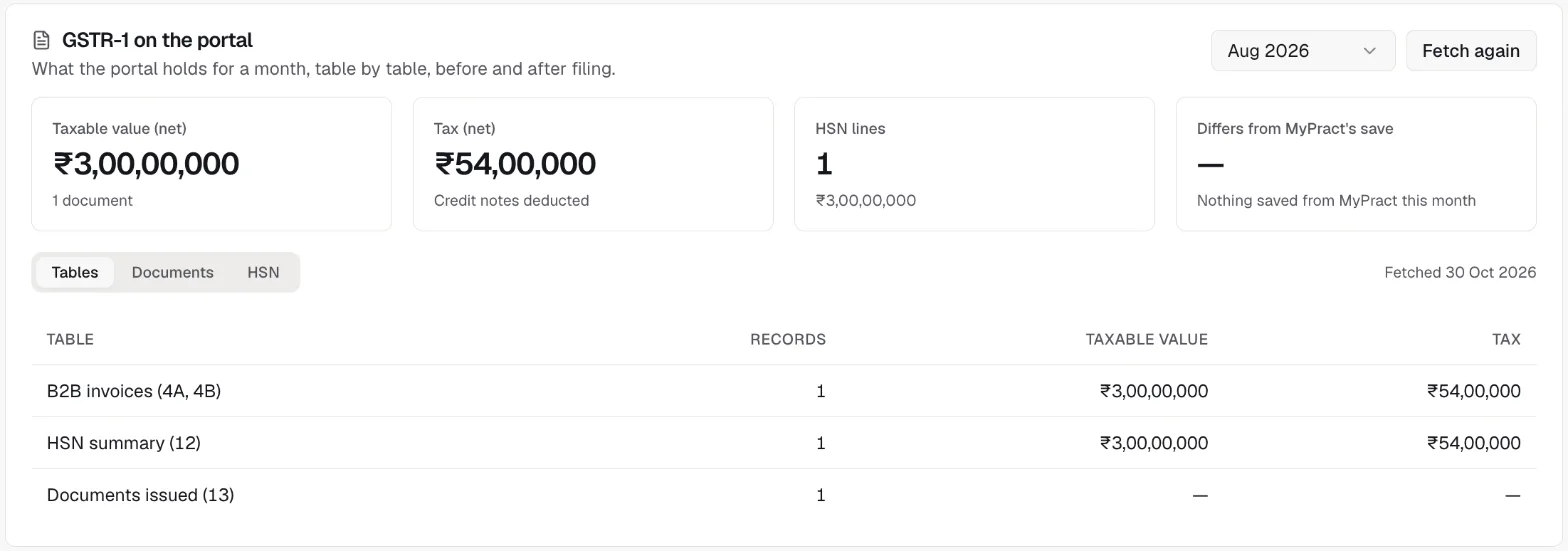
When a month's figures disagree, the GSTR-1 on the portal card shows what the portal holds for that month, table by table: B2B invoices (4A, 4B), B2C large and others, credit and debit notes (9B), exports (6A), nil-rated and exempt (8), the HSN summary (12) and documents issued (13), with the records, taxable value and tax in each. The Documents and HSN tabs list the lines behind the totals. That is usually enough to see whether the gap is a missing invoice, a credit note or an HSN mismatch.
Try MyPract free for 3 months
No card required, and the trial never converts to a paid plan automatically.
Start your free trialHow do you reconcile ITC in GSTR-3B with GSTR-2B and Table 8A?
From FY 2023-24, Table 8A of GSTR-9 is auto-populated from the year's GSTR-2B statements, excluding imports and reverse charge[6]. Table 8B is what you claimed in GSTR-3B, and Table 8D is the difference. Check, month by month:
- ITC claimed in 3B against ITC available in 2B. A month where 3B claims more than 2B needs an explanation (an invoice that appeared in a later month's 2B) or a reversal.
- Invoices of the year that landed in next year's 2B, because the supplier filed late. These are claimed in a GSTR-3B of the next year by 30 November and reported in Tables 8C and 13, not in 8A[6].
- Reversals, under rule 37 (payment not made within 180 days), rule 42 and 43 (exempt supplies) and section 17(5) (blocked credit), which should match Table 4B of the GSTR-3Bs.
- Your purchase register against GSTR-2B, for credit you are still entitled to before the 30 November cut-off.
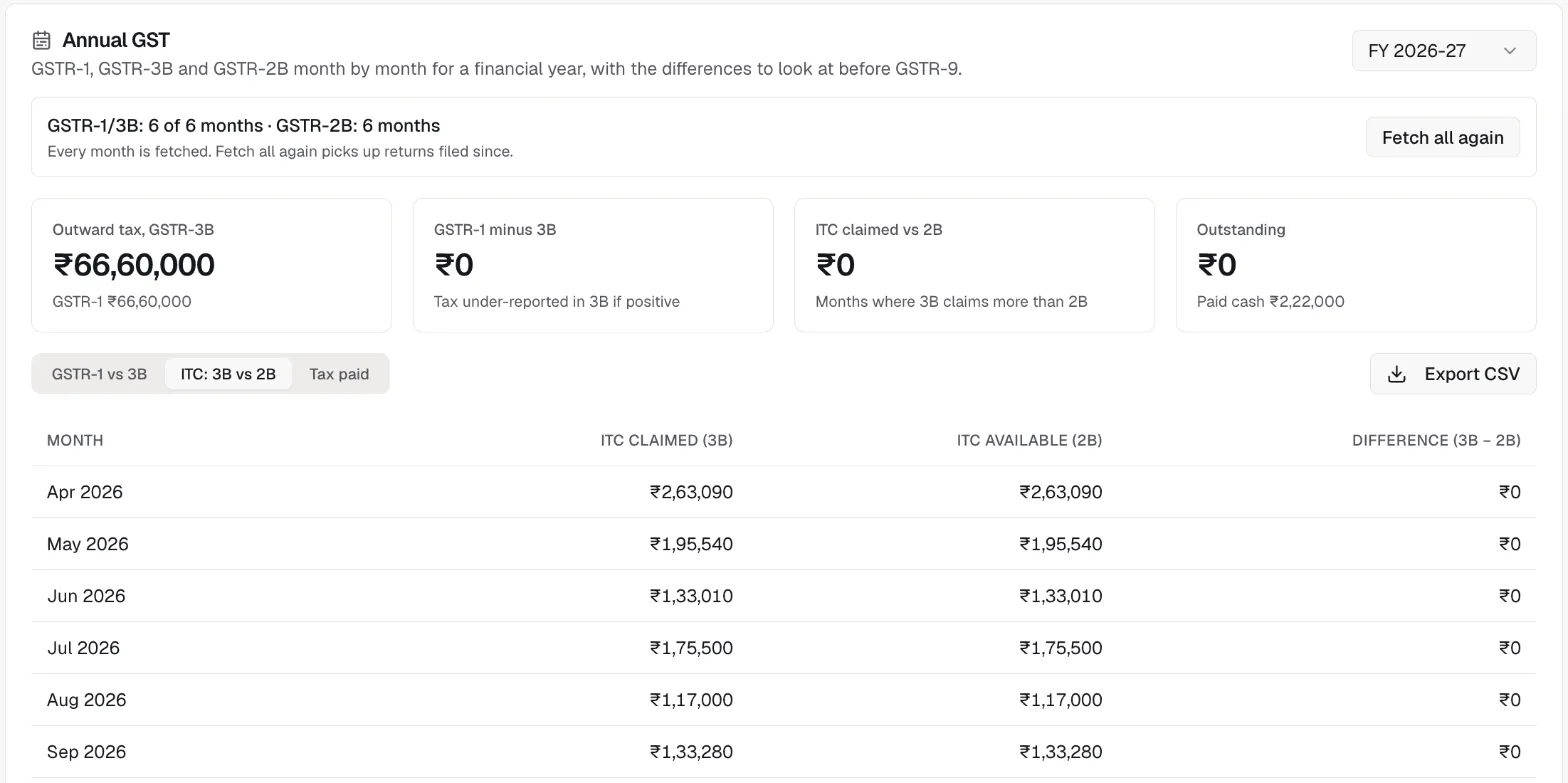
In MyPract, the ITC: 3B vs 2B tab of the same Annual GST card lists the ITC claimed in each month's GSTR-3B against the ITC available in that month's GSTR-2B, with the difference and the year total. For the invoice-level match against the purchase register, and for suppliers who have not filed at all, use the GSTR-2B reconciliation and GSTR-2A cards, explained in our guide to GSTR-2A vs GSTR-2B reconciliation.
How do you check tax paid before GSTR-9?
GSTR-9 Table 9 reports tax payable and tax paid, in cash and through ITC, for each tax head. Before filing:
- Liability against payment for each month: anything still outstanding should be paid before the annual return, with interest under section 50.
- Cash paid against the electronic cash ledger and ITC used against the credit ledger, to catch challans paid but not offset.
- DRC-03 payments made during the year for earlier differences, which go in Table 9 and Table 14 as applicable.
The Tax paid tab of MyPract's Annual GST card lists, per month, the liability, tax paid in cash, tax paid through ITC and anything outstanding, from the ledgers read from the portal.
What is a practical GSTR-9 checklist for a CA firm?
| Step | Check | When |
|---|---|---|
| 1 | Fetch the whole year from the portal: GSTR-1, GSTR-3B summaries, ledgers, GSTR-2B | Early October |
| 2 | GSTR-1 vs GSTR-3B, month by month; pay any short-declared tax by DRC-03 | October |
| 3 | ITC: 3B vs 2B month by month, and purchase register vs 2B; claim missed ITC in a current 3B | By 30 November |
| 4 | Credit notes and GSTR-1 amendments of the year declared | By 30 November |
| 5 | Tax paid vs liability; ledgers vs challans | November |
| 6 | Table 8A vs 8B, 8C and 13 explained; HSN summary (Table 17) ready | December |
| 7 | GSTR-9 prepared, reviewed and filed on the portal; GSTR-9C if turnover is above ₹5 crore | By 31 December |
With many clients, the routine works best as one engagement per client for the annual return, with a task per step, a named preparer and reviewer, and the reconciliation CSV saved to the client's documents. The Annual GST card's Export CSV downloads the month-wise table for the tab in view. See how this fits with the rest of the busy season in our tax audit season workflow.
MyPract does not file the annual return: it reads the portal data so the firm can reconcile the year, and GSTR-9 is filed on the GST portal. What it reads, and what it doesn't do, is listed on our facts page; for how it compares with other practice software, see the best practice management software for CA firms.
Try MyPract free for 3 months
No card required, and the trial never converts to a paid plan automatically.
Start your free trialHow we checked
The GSTR-9 due date and the ₹2 crore exemption were checked on 30 October 2026 against section 44 of the CGST Act, rule 80 of the CGST Rules and Notification 15/2025-Central Tax; the ITC and credit-note cut-offs against sections 16(4) and 34(2); and the Table 8A source against the GSTN advisory on Table 8A and 8C. The MyPract screenshots were taken from a live workspace on 30 October 2026 after fetching a real GSTIN's year from the portal; every client and supplier name, GSTIN and invoice number was replaced and every amount scaled before capture, so the figures are samples.
Frequently asked questions
What is the due date for GSTR-9?
GSTR-9 is due by 31 December following the end of the financial year, under section 44 of the CGST Act read with rule 80. For FY 2025-26 that is 31 December 2026, unless the government extends it by notification.
Who is exempt from filing GSTR-9?
Taxpayers whose aggregate turnover for the year is up to ₹2 crore. Notification 15/2025-Central Tax exempts them from FY 2024-25 onwards. Composition taxpayers file GSTR-9A instead, and input service distributors, non-resident taxable persons and TDS/TCS deductors do not file GSTR-9.
Where does Table 8A of GSTR-9 come from?
From FY 2023-24, Table 8A is auto-populated from the year's GSTR-2B statements (excluding imports and reverse-charge supplies). Earlier years used GSTR-2A, which is why older Table 8A figures often differ from what the purchase register shows.
Can I still claim last year's ITC before filing GSTR-9?
Yes, up to the earlier of 30 November after the financial year or the date you file GSTR-9 (section 16(4)). Claim it in a GSTR-3B of the following year before then, and report it in Table 8C and Table 13 of GSTR-9. Filing GSTR-9 early closes that window.
Does MyPract file GSTR-9?
No. MyPract reads GSTR-1, GSTR-3B summaries, ledgers and GSTR-2B from the GST portal through a GSTN-licensed GST Suvidha Provider and shows them month by month for the year, so you can reconcile before filing. The annual return is filed on the GST portal. See the facts page.
Sources
[1] CBIC, "CGST Act, 2017: Section 44, Annual return", https://taxinformation.cbic.gov.in/content/html/tax_repository/gst/acts/2017_CGST_act/active/chapter9/section44_v1.00.html (checked 30 October 2026).
[2] CBIC, "CGST Rules, 2017: Rule 80, Annual return", https://taxinformation.cbic.gov.in/content/html/tax_repository/gst/rules/cgst_rules/active/chapter8/rule80_v1.00.html (checked 30 October 2026).
[3] Lexplosion, report on Notification 15/2025-Central Tax (GSTR-9 exemption up to ₹2 crore from FY 2024-25), https://lexplosion.in/cbic-exempts-taxpayers-with-aggregate-turnover-upto-rs-2-crores-from-filing-gst-annual-return-for-financial-year-2024-25-onwards/ (checked 30 October 2026).
[4] EY, Tax Alert on the Kerala High Court ruling on the 30 November time limit for ITC under section 16(4), https://ey.com/en_in/alerts-hub/2024/06/kerala-hc-holds-30-november-time-limit-for-claiming-itc-applies-retrospectively-from-1-july-2017 (checked 30 October 2026).
[5] Taxguru, "Section 34: understanding credit notes under GST", https://taxguru.in/goods-and-service-tax/section-34-understanding-credit-notes-gst.html (checked 30 October 2026).
[6] GSTN, "Advisory on difference in value of Table 8A and 8C of Annual Returns FY 23-24", https://www.mahagst.gov.in/public/uploads/gstnadvisory/1760530133_307.Advisory%20on%20difference%20in%20value%20of%20Table%208A%20and%208C%20of%20Annual%20Returns%20FY%2023-24.pdf (checked 30 October 2026).
Related reading
- How to File GST Returns Online: GSTR-1, GSTR-3B and GSTR-9 Step by Step (2026)File GSTR-1 and GSTR-3B on the GST portal step by step: 2026 due dates, GSTR-2B ITC reconciliation, payment and offset, GSTR-9 and pre-filing checks.
- GSTR-2A vs GSTR-2B: How to Reconcile Them Month by Month and for the YearGSTR-2A changes, GSTR-2B is frozen on the 14th. How to reconcile them each month and for the year, find suppliers who haven't filed and late filings.
- How to Run Tax Audit Season End to End: A Workflow for CA FirmsRun tax audit season end to end: client intake, document requests, Form 3CD stages, review, UDIN, the 21 October 2026 due date and status tracking.
- Best Practice Management Software for CA Firms in India (2026)Which practice management software suits which CA firm in 2026: MyPract, Jamku, ERPCA, Zoho Practice, CCH iFirm, TaxDome, Karbon and XPM compared.
Start with the best practice management software for CA firms, or see every comparison, MyPract pricing, all features or MyPract at a glance.