Old vs New Tax Regime for FY 2025-26: Slabs, Deductions and Two Worked Examples
Short answer: for FY 2025-26 (AY 2026-27) the new regime is cheaper for most individuals: lower slabs, a ₹75,000 standard deduction and a section 87A rebate that makes taxable income up to ₹12 lakh tax-free for residents. The old regime still wins for some clients with large HRA, home-loan interest and full Chapter VI-A claims, so compute both with the client's real figures before choosing.
Last updated 30 October 2026. Rates are for FY 2025-26 (AY 2026-27) for individuals under the Income-tax Act, 1961.
FY 2025-26 is the last year assessed under the 1961 Act. The Income-tax Act, 2025 came into force on 1 April 2026 and applies from tax year 2026-27, according to CBDT[1]. Returns for the year ended 31 March 2026 are still filed under section 115BAC of the old Act, with the rates below.
What are the new regime slabs for FY 2025-26?
The new regime under section 115BAC(1A) is the default for individuals[2]. Finance Act 2025 widened every slab and raised the rebate[3].
| Taxable income (new regime) | Rate |
|---|---|
| Up to ₹4,00,000 | Nil |
| ₹4,00,001 to ₹8,00,000 | 5% |
| ₹8,00,001 to ₹12,00,000 | 10% |
| ₹12,00,001 to ₹16,00,000 | 15% |
| ₹16,00,001 to ₹20,00,000 | 20% |
| ₹20,00,001 to ₹24,00,000 | 25% |
| Above ₹24,00,000 | 30% |
- Standard deduction: ₹75,000 for salary and pension.
- Section 87A rebate: up to ₹60,000 for a resident whose taxable income is ₹12 lakh or less, so the tax on that income is nil[3]. The rebate does not apply to income taxed at special rates, such as capital gains under sections 111A and 112.
- Marginal relief: just above ₹12 lakh, the tax cannot exceed the income above ₹12 lakh. It stops mattering at about ₹12.7 lakh of taxable income.
- Surcharge: 10% above ₹50 lakh, 15% above ₹1 crore and 25% above ₹2 crore, with marginal relief at each threshold. The new regime has no 37% band.
- Cess: 4% health and education cess on tax plus surcharge, in both regimes.
What are the old regime slabs?
The old regime slabs have not changed for years. The basic exemption is higher for resident senior citizens[4].
| Taxable income (old regime) | Below 60 | 60 to 79 (resident) | 80 and above (resident) |
|---|---|---|---|
| Up to ₹2,50,000 | Nil | Nil | Nil |
| ₹2,50,001 to ₹3,00,000 | 5% | Nil | Nil |
| ₹3,00,001 to ₹5,00,000 | 5% | 5% | Nil |
| ₹5,00,001 to ₹10,00,000 | 20% | 20% | 20% |
| Above ₹10,00,000 | 30% | 30% | 30% |
The standard deduction is ₹50,000, the 87A rebate is up to ₹12,500 for a resident with taxable income up to ₹5 lakh, and surcharge runs 10%, 15%, 25% and 37% (above ₹5 crore).
Try MyPract free for 3 months
No card required, and the trial never converts to a paid plan automatically.
Start your free trialWhich deductions does each regime allow?
This is where the decision is made. The new regime gives up almost every deduction in exchange for the lower slabs.
| Deduction or exemption | Old regime | New regime |
|---|---|---|
| Standard deduction (salary) | ₹50,000 | ₹75,000 |
| HRA exemption, section 10(13A) | Yes | No |
| Interest on a self-occupied home loan, section 24(b) | Up to ₹2,00,000 | No |
| Loss from house property set off against other income | Up to ₹2,00,000 | No |
| 80C (PF, PPF, ELSS, LIC, tuition fees, principal on a home loan) | Up to ₹1,50,000 | No |
| 80CCD(1B), own NPS contribution | Up to ₹50,000 | No |
| 80CCD(2), employer's NPS contribution | Up to 10% of salary | Up to 14% of salary |
| 80D, health insurance | ₹25,000 (₹50,000 senior), plus the same for parents | No |
| 80E, 80G, 80GG, 80EEB, 80TTA / 80TTB | Yes, within their limits | No |
On a let-out property, the 30% standard deduction and interest are allowed in both regimes; only the set-off of the loss differs.
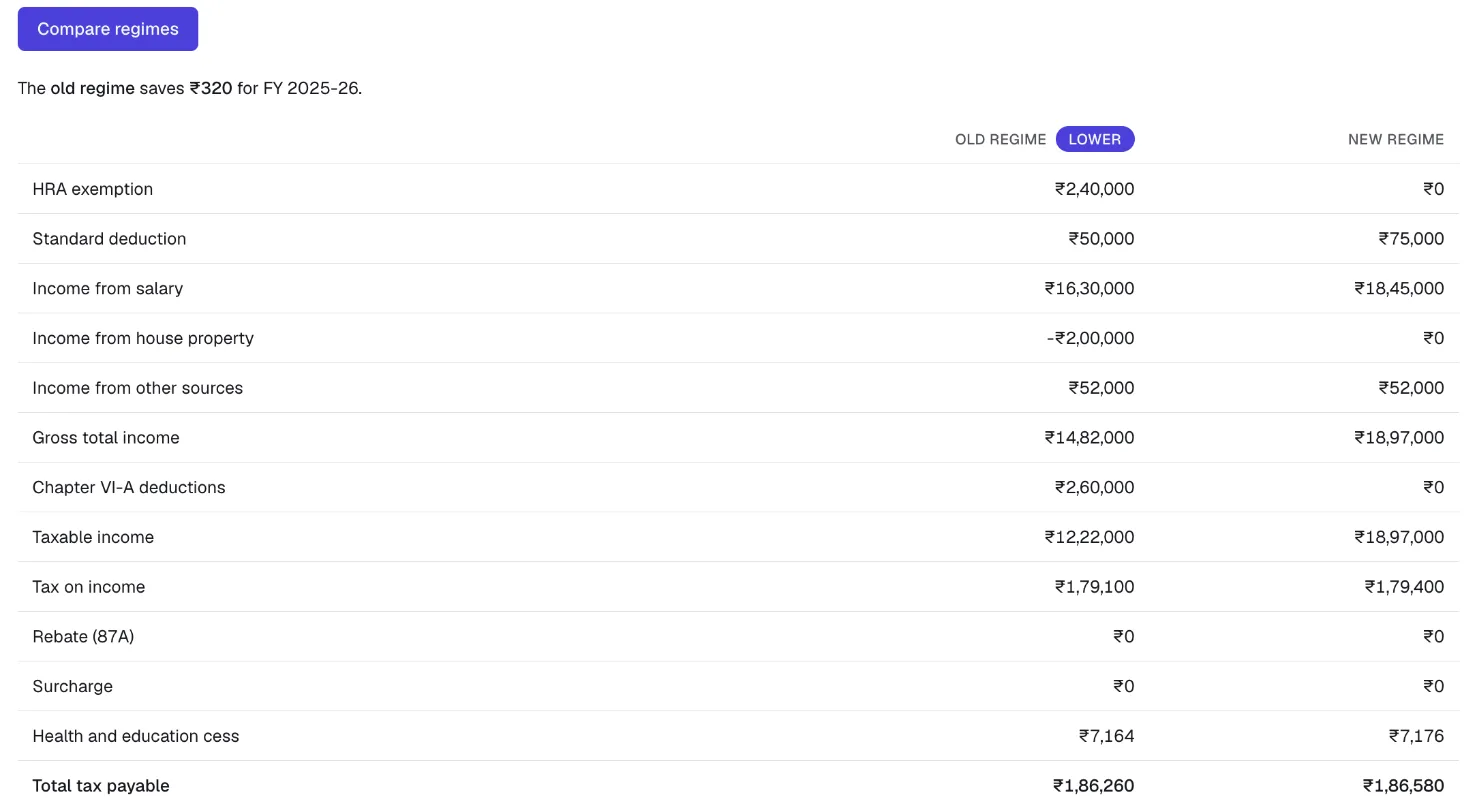
Worked example 1: the old regime wins, by ₹320
A salaried client, aged 35, resident, living in a metro, with every common deduction:
- Basic salary ₹12,00,000; HRA received ₹4,80,000; rent paid ₹3,60,000; other allowances ₹2,40,000.
- Interest on a self-occupied home loan ₹2,00,000.
- Savings interest ₹12,000; FD interest ₹40,000.
- 80C ₹1,50,000; 80CCD(1B) ₹50,000; 80D ₹25,000 for self and ₹50,000 paid for parents who are not senior citizens.
| Old regime | New regime | |
|---|---|---|
| HRA exemption | ₹2,40,000 | ₹0 |
| Standard deduction | ₹50,000 | ₹75,000 |
| Income from salary | ₹16,30,000 | ₹18,45,000 |
| Income from house property | −₹2,00,000 | ₹0 |
| Income from other sources | ₹52,000 | ₹52,000 |
| Gross total income | ₹14,82,000 | ₹18,97,000 |
| Chapter VI-A deductions | ₹2,60,000 | ₹0 |
| Taxable income | ₹12,22,000 | ₹18,97,000 |
| Tax on income | ₹1,79,100 | ₹1,79,400 |
| Health and education cess | ₹7,164 | ₹7,176 |
| Total tax payable | ₹1,86,260 | ₹1,86,580 |
How the old-regime figures are reached:
- HRA exemption is the least of HRA received (₹4,80,000), rent paid minus 10% of basic (₹2,40,000) and 50% of basic for a metro (₹6,00,000).
- Chapter VI-A is 80C ₹1,50,000 + 80CCD(1B) ₹50,000 + 80D ₹25,000 for self + ₹25,000 for parents (the limit when they are not seniors) + 80TTA ₹10,000 on the savings interest.
- Rounding: totals are rounded to the nearest ₹10 under section 288B.
The two totals are only ₹320 apart. Drop the home loan or the HRA and the new regime wins, so treat a close result as a reason to check the client's figures, not as a reason to stay put.
Worked example 2: the new regime wins, with marginal relief
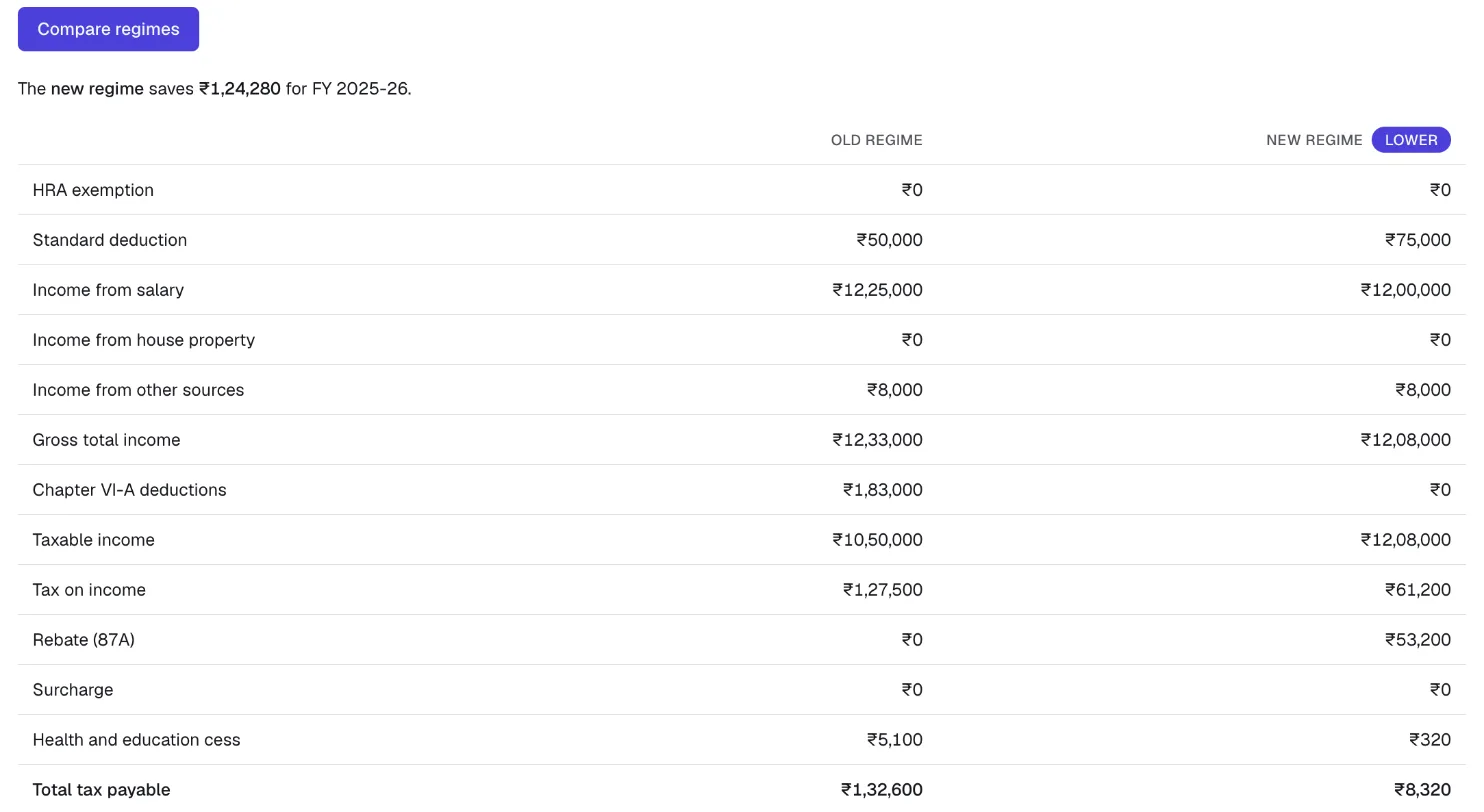
A salaried client with basic salary of ₹12,75,000, savings interest of ₹8,000, 80C of ₹1,50,000 and 80D of ₹25,000, no HRA and no home loan:
| Old regime | New regime | |
|---|---|---|
| Income from salary | ₹12,25,000 | ₹12,00,000 |
| Income from other sources | ₹8,000 | ₹8,000 |
| Gross total income | ₹12,33,000 | ₹12,08,000 |
| Chapter VI-A deductions | ₹1,83,000 | ₹0 |
| Taxable income | ₹10,50,000 | ₹12,08,000 |
| Tax on income | ₹1,27,500 | ₹61,200 |
| Rebate (87A) | ₹0 | ₹53,200 |
| Health and education cess | ₹5,100 | ₹320 |
| Total tax payable | ₹1,32,600 | ₹8,320 |
The ₹8,000 of savings interest takes taxable income ₹8,000 past ₹12 lakh, so the full rebate is lost. Slab tax is ₹61,200. Marginal relief limits the tax to the ₹8,000 above ₹12 lakh, which is why the rebate line shows ₹53,200. With 4% cess the total is ₹8,320, and the new regime saves ₹1,24,280.
Who can switch, and when?
- Salaried and other individuals without business income choose the regime in the return each year. Tell the employer the intended regime at the start of the year so TDS on salary is right, but the choice made in the ITR is what counts.
- Individuals with business or professional income are in the new regime by default. To use the old regime they file Form 10-IEA on or before the section 139(1) due date, and they can come back to the new regime only once while that income continues[5].
- A late return under the default regime: under section 115BAC(6), someone without business income can choose the old regime only in a return filed by the due date under section 139(1), so a belated return is taxed under the new regime.
A checklist for comparing regimes for each client
- Collect the year's Form 16 or salary slips, rent receipts and the landlord's PAN if rent is above ₹1 lakh a year, the home-loan interest certificate, and proofs for 80C, 80CCD and 80D.
- Check the AIS for interest, dividends and other income the client did not mention. Interest alone can push a client past ₹12 lakh, as in example 2.
- Compute HRA exemption with the right city (50% of basic in Mumbai, Kolkata, Delhi and Chennai; 40% elsewhere).
- Apply each deduction's limit, not the amount paid: 80C ₹1.5 lakh in total, 80D by age, 80TTA ₹10,000 (80TTB ₹50,000 for resident seniors).
- Compute the tax both ways, including rebate, marginal relief, surcharge and cess, and round under section 288B.
- Note special-rate income separately: capital gains under sections 111A and 112 are taxed at their own rates and get no 87A rebate.
- Record the comparison and the regime chosen in the client file, and for business clients diarise Form 10-IEA before the due date.
How MyPract's regime comparison works
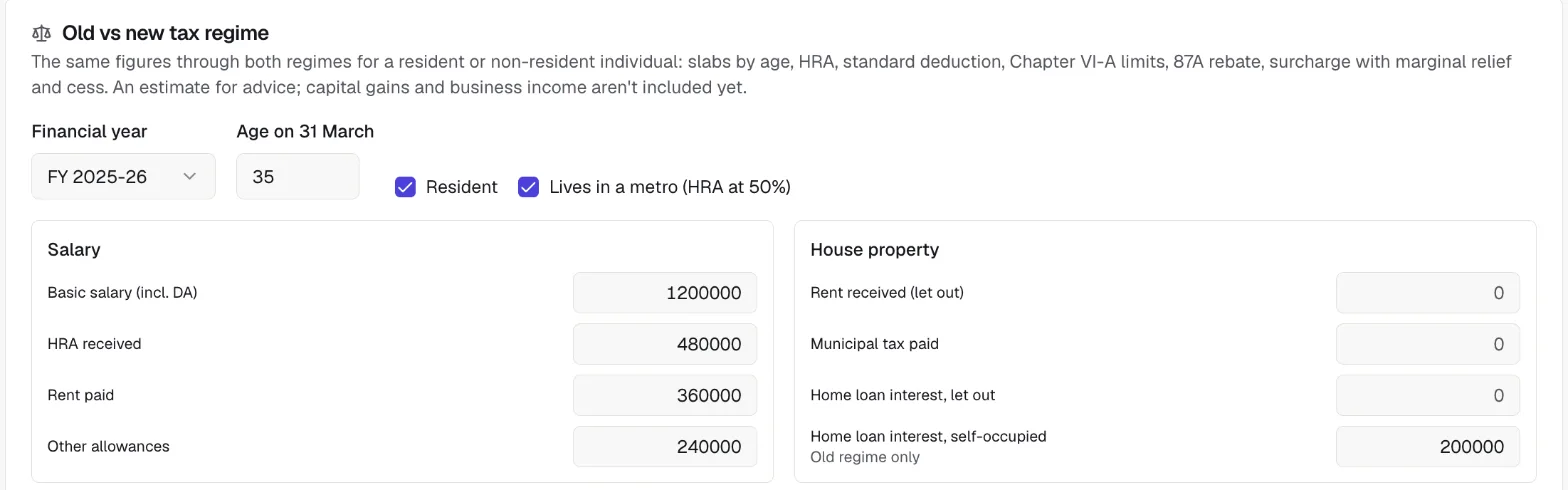
MyPract is a global, AI-native practice management platform for accounting, audit and tax teams. For Indian clients, a staff member opens the client's Income tax tab and fills in the old vs new regime card:
- Year and person: financial year (FY 2023-24, 2024-25 or 2025-26), age on 31 March, resident or non-resident, and whether the client lives in a metro.
- Salary: basic salary including DA, HRA received, rent paid and other allowances.
- House property: rent received, municipal tax, and interest on a let-out and on a self-occupied loan.
- Other sources: savings interest, FD and RD interest, dividends and other income.
- Deductions: 80C, 80CCD(1B), 80CCD(2), 80D for self and for parents (with a senior-citizen tick), 80E, 80G, 80GG and 80EEB.
MyPract applies the limits, slabs by age, the 87A rebate with the new regime's marginal relief, surcharge with marginal relief and cess, and shows both computations side by side with the cheaper regime marked. Each run is saved on the client under Earlier comparisons, so next year's discussion starts from this year's numbers.
Know its limits before relying on it:
- It is an estimate for advice. Capital gains and business income aren't included yet, and neither are the 15% surcharge cap on dividends, professional tax, family pension or agricultural income.
- It does not connect to the Income Tax portal and does not file the return; staff enter the figures, and the ITR is filed on the portal or through tax software.
- It does not replace checking the AIS and Form 26AS for the year.
See the facts page for exactly what MyPract does and does not do, the features page for the rest of the product, and the best practice management software for tax consultants or for CA firms if you are choosing a system.
Try MyPract free for 3 months
No card required, and the trial never converts to a paid plan automatically.
Start your free trialHow we checked
We took the slabs, rebate, standard deduction and surcharge for FY 2025-26 from the Income Tax Department's rate charts and its section 87A FAQ, the regime and Form 10-IEA rules from the department's Form 10-IEA page, and the commencement of the Income-tax Act, 2025 from CBDT's press release, all checked on 30 October 2026. Both worked examples were run in MyPract on 30 October 2026 on sample data and checked line by line by hand.
Frequently asked questions
Which tax regime is better for FY 2025-26?
For most individuals the new regime, because its slabs are lower and resident taxpayers with taxable income up to ₹12 lakh pay no tax after the ₹60,000 section 87A rebate. The old regime can still be cheaper when large HRA exemption, self-occupied home-loan interest and full 80C, 80CCD(1B) and 80D claims are all available. Compute the tax both ways with the client's actual figures before deciding.
Is salary up to ₹12.75 lakh tax-free under the new regime?
For a resident salaried individual with no other income, yes in practice. The ₹75,000 standard deduction brings ₹12.75 lakh of salary down to ₹12 lakh of taxable income, and the section 87A rebate of up to ₹60,000 cancels the tax on that. Income taxed at special rates, such as capital gains under sections 111A and 112, does not get the rebate.
What is marginal relief under the new regime?
When taxable income is just above ₹12 lakh, the tax payable cannot exceed the income above ₹12 lakh. At ₹12,08,000 of taxable income the slab tax is ₹61,200, but the tax is limited to ₹8,000, plus 4% cess, so the total is ₹8,320.
Can a salaried person switch between the old and new regime every year?
Yes. An individual without business or professional income chooses the regime in the return each year. Someone with business or professional income who wants the old regime files Form 10-IEA by the section 139(1) due date, and can switch back to the new regime only once.
Does MyPract file the return or read the Income Tax portal?
No. MyPract's regime comparison is computed from figures staff enter on the client's Income tax tab and is saved on the client as an estimate for advice. It does not connect to the Income Tax portal and does not file the return; the ITR is filed on the Income Tax portal or through tax software.
Sources
[1] CBDT, "Income-tax Act, 2025 comes into force from 01 April 2026" (press release), https://www.incometaxindia.gov.in/documents/d/guest/press-release-income-tax-act-2025-comes-into-force-from-01-april-2026-pdf (checked 30 October 2026).
[2] Income Tax Department, "Form 10-IEA", https://www.incometaxindia.gov.in/w/form_10-iea (checked 30 October 2026).
[3] Income Tax Department, "What is rebate under section 87A for F.Y. 2025-26 and who can claim it?", https://www.incometaxindia.gov.in/w/what-is-rebate-under-section-87a-for-f.y-2025-26-and-who-can-claim-it- (checked 30 October 2026).
[4] Income Tax Department, "Tax rates for individuals and HUFs", https://incometaxindia.gov.in/Charts%20%20Tables/Tax-rates-for-last-10-years/Individual-and-HUFs-Tax%20Rates.html (checked 30 October 2026).
[5] Income Tax Department, "Form 10-IEA user manual", https://www.incometax.gov.in/iec/foportal/help/statutory-forms/popular-form/form-10-IEA-um (checked 30 October 2026).
Related reading
- Best Practice Management Software for Tax Consultants in India (2026)Which office software fits Indian tax consultants and GST practitioners: notices, return volume, GST data, filing tools and year-one cost, compared.
- Best Practice Management Software for CA Firms in India (2026)Which practice management software suits which CA firm in 2026: MyPract, Jamku, ERPCA, Zoho Practice, CCH iFirm, TaxDome, Karbon and XPM compared.
- How to File GST Returns Online: GSTR-1, GSTR-3B and GSTR-9 Step by Step (2026)File GSTR-1 and GSTR-3B on the GST portal step by step: 2026 due dates, GSTR-2B ITC reconciliation, payment and offset, GSTR-9 and pre-filing checks.
Start with the best practice management software for CA firms, or see every comparison, MyPract pricing, all features or MyPract at a glance.